Airtable vs ClickUp: a shared database or a connected workspace?
Airtable starts with the information your operation needs to remember. ClickUp starts with work that needs to get done and brings documents and conversations alongside it. Both can support a launch, but they organize its context in different ways.
Airtable
Full profile & featuresBest fit
Teams building a shared operational system around related content, clients, assets or projects.
$20paid plans from
USD / billable collaborator / month, billed annually · Team

ClickUp
Full profile & featuresBest fit
Teams keeping detailed tasks, working documents and project conversations in one configurable workspace.
$7paid plans from
USD / user / month, billed annually · Unlimited
The decision
Our verdict
Choose Airtable when projects must connect to a lasting record of clients, campaigns, content or assets, and the team is willing to design that structure. Choose ClickUp when detailed tasks, briefs and discussion should share a workspace. ClickUp has a lower paid entry rate; Airtable Team deserves its place when the relational model and tailored interfaces are what the team needs.
Airtable: strengths & tradeoffs
Why choose it
- Linked records connect different kinds of information without copying each relationship into a task description.
- Grid, calendar and Kanban can present the same records for different jobs.
- Interfaces can give a team a focused way to work with its underlying data.
Weigh up
- Someone needs to design the tables, relationships and permissions before the workflow becomes useful.
- Record capacity, automation allowances and collaborator billing matter alongside the seat price.
ClickUp: strengths & tradeoffs
Why choose it
- A task can stay connected to the brief or document explaining the work.
- Lists, boards, planning views, Docs and Chat support several work habits in one workspace.
- Free Forever allows unlimited members, with defined storage and feature limits.
Weigh up
- Spaces, folders, lists and overlapping surfaces need an agreed setup to remain coherent.
- A workspace upgrade and AI add-ons can cost more than the headline per-user subscription.
Airtable vs ClickUp at a glance
Paid planning step[3][4][9]
- Airtable
- Team includes Timeline and Gantt and raises capacity to 50,000 records per base. Choose it for both view access and the amount of data the workflow needs.
- ClickUp
- Unlimited includes unlimited Gantt charts, custom fields and native time tracking. Business adds advanced dashboard cards and 5,000 monthly automation executions.
Features: how the work gets done
These differences matter when the team moves from a useful view to an everyday working process. The recommendations below follow the kind of work each product organizes.
Work structure[2][8]
- Airtable
- Records can represent more than assignments: a client, campaign, asset and task can each have their own table, connected through linked-record fields.
- ClickUp
- Tasks support subtasks, checklists, relationships and custom fields. The workspace hierarchy can separate different projects while retaining detailed assignments.
Our take: Airtable treats clients, assets and tasks as different kinds of connected records. ClickUp keeps detailed assignments at the center of a task hierarchy.
Scheduling and views[4][9]
- Airtable
- Grid, calendar and Kanban offer different perspectives on a base. Team adds Timeline and Gantt; date ranges and multiple calendar date fields also require a paid plan.
- ClickUp
- List, Board and Calendar show different perspectives on tasks. Unlimited adds unlimited Gantt charts and native time tracking for teams that need scheduling and effort data.
Our take: Compare the planning tiers directly: Airtable Team and ClickUp Unlimited both include Gantt, with different capacity, collaboration and reporting allowances.
Intake, documents and discussion[5][8]
- Airtable
- Forms collect records and Interface Designer creates focused pages over a base. Separate interface sharing and more presentation controls depend on the plan.
- ClickUp
- Docs, comments, Chat and Whiteboards keep written context and discussion near the work. In our recorded launch workflow, the brief linked to its approval task.
Our take: ClickUp makes the linked brief-and-task workflow a natural fit. Airtable is useful when the brief or asset needs structured fields and relationships of its own.
Reporting and coordination[5][9]
- Airtable
- Interfaces and views can summarize operational data for a particular audience. The structure and fields you build determine what those summaries can answer.
- ClickUp
- Dashboards summarize workspace work. Business adds advanced dashboard cards and higher automation capacity; it is a different reporting package from Unlimited.
Our take: Airtable interfaces can be shaped for operational roles. ClickUp Business is the tier to examine when advanced dashboard cards are a requirement.
Automation and AI[6][4][8][11]
- Airtable
- Automations trigger actions from record changes or schedules. Runs are metered per workspace; AI also has plan-specific credits. Define the process before automating it.
- ClickUp
- Rules and automations connect task changes to actions. Brain and agent capabilities add AI with their own offer/usage limits. Check generated claims against the underlying task data.
Our take: Both can automate work, but the unit of usage and AI offer differ. A larger numerical allowance does not establish that the same process costs less.
Pricing & the cost of your team
Public USD rates checked October 16, 2026. Annual rates require annual billing; the monthly alternatives are shown separately. Compare the tier that includes the required planning and coordination features.
Paid subscription rates[3][4][9]
- Airtable
- Team is $20 per billable collaborator/month annually or $24 monthly. Business is $45 annually or $54 monthly; Enterprise Scale is quoted.
- ClickUp
- Unlimited is $7 per user/month annually or $10 monthly. Business is $12 annually or $19 monthly; Enterprise is quoted.
The planning package[3][4][9]
- Airtable
- Team includes Timeline and Gantt and raises capacity to 50,000 records per base. Choose it for both view access and the amount of data the workflow needs.
- ClickUp
- Unlimited includes unlimited Gantt charts, custom fields and native time tracking. Business adds advanced dashboard cards and 5,000 monthly automation executions.
Who becomes billable[3][4][9]
- Airtable
- Self-serve plans apply to a workspace. Team bills Commenters and higher permissions, including relevant interface collaborators; self-serve Business generally bills Editors and above.
- ClickUp
- An upgrade applies to the workspace, including its members. Guest roles and permissions affect which collaborators become billable.
What changes the total[3][4][9]
- Airtable
- Check attachment/record capacity, AI credits and automation limits. A private company email domain is required for Business and Enterprise Scale.
- ClickUp
- Brain/AI add-ons and differing workspace offers have their own pricing and allowances. Check the full account offer before treating the seat rate as an all-in cost.
A 10-person planning budget
The selected tiers both include Gantt planning. Assume ten billable collaborators in one workspace. ClickUp Unlimited also includes native time tracking; Airtable Team supplies its record capacity and database-oriented workflows. These are different packages.
Airtable Team
$2,400/ year
10 seats × $20 × 12 months
ClickUp Unlimited
$840/ year
10 seats × $7 × 12 months
Base subscription for ten billable people, billed annually. Excludes taxes, AI usage/add-ons, external services, marketplace purchases, promotions and negotiated discounts. Check the final account quote, permissions and guest roles before purchase.
Connect the tools you already use
A connection name is only the beginning. Check which event starts the workflow, what information moves, and whether the connection is one-way, two-way or dependent on a paid tier.
Files and connected information[7][3][10][9]
- Airtable
- Google Drive and other integrations can connect source information with a base. Decide which system owns each field before setting up sync.
- ClickUp
- Google Drive, Outlook and Google Calendar are listed integrations, with different file, email and calendar capabilities.
Custom workflows and limits[7][3][10][9]
- Airtable
- Automations and the API support custom processes, with plan-specific run, API and sync allowances. A linked-record field itself is not an external integration.
- ClickUp
- Unlimited includes unlimited integrations, while API and automation usage retain separate allowances. Verify the exact event and sync direction required.
Who each product fits
Choose the information model before the view: a campaign may need a persistent database of assets and channels, or a task workspace with a brief and delivery checklist. That distinction matters more than whether both products can draw a board.
The interface and everyday use
Airtable
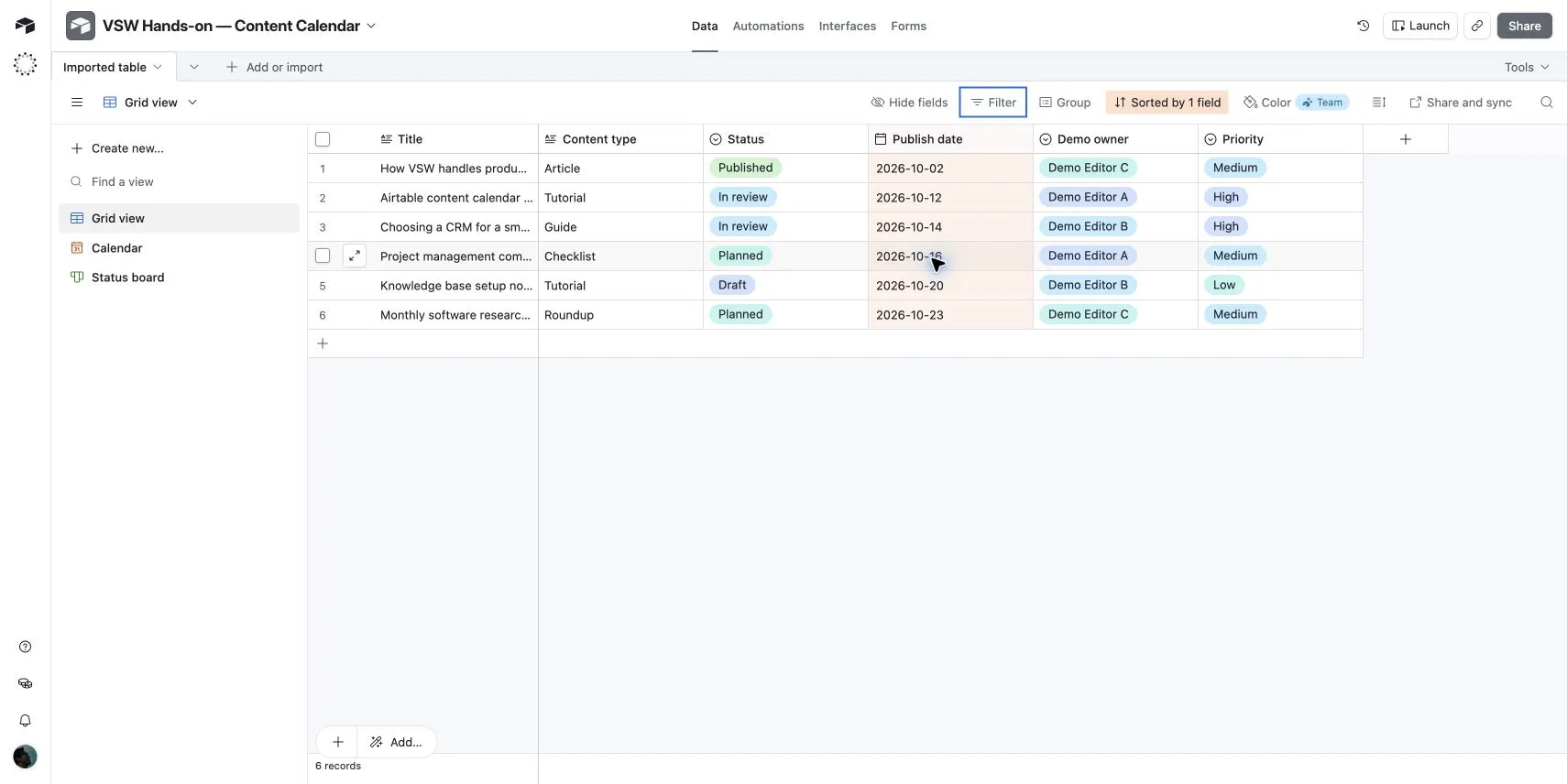
In our recorded Free-plan content calendar, one set of records appeared as a grid, calendar and status board. A status edit carried from the board to the grid. That supports a practical benefit: different teams can view shared information in different ways. Setting up the underlying fields and choosing which fields are visible remain part of the work.
Explore Airtable in detailClickUp
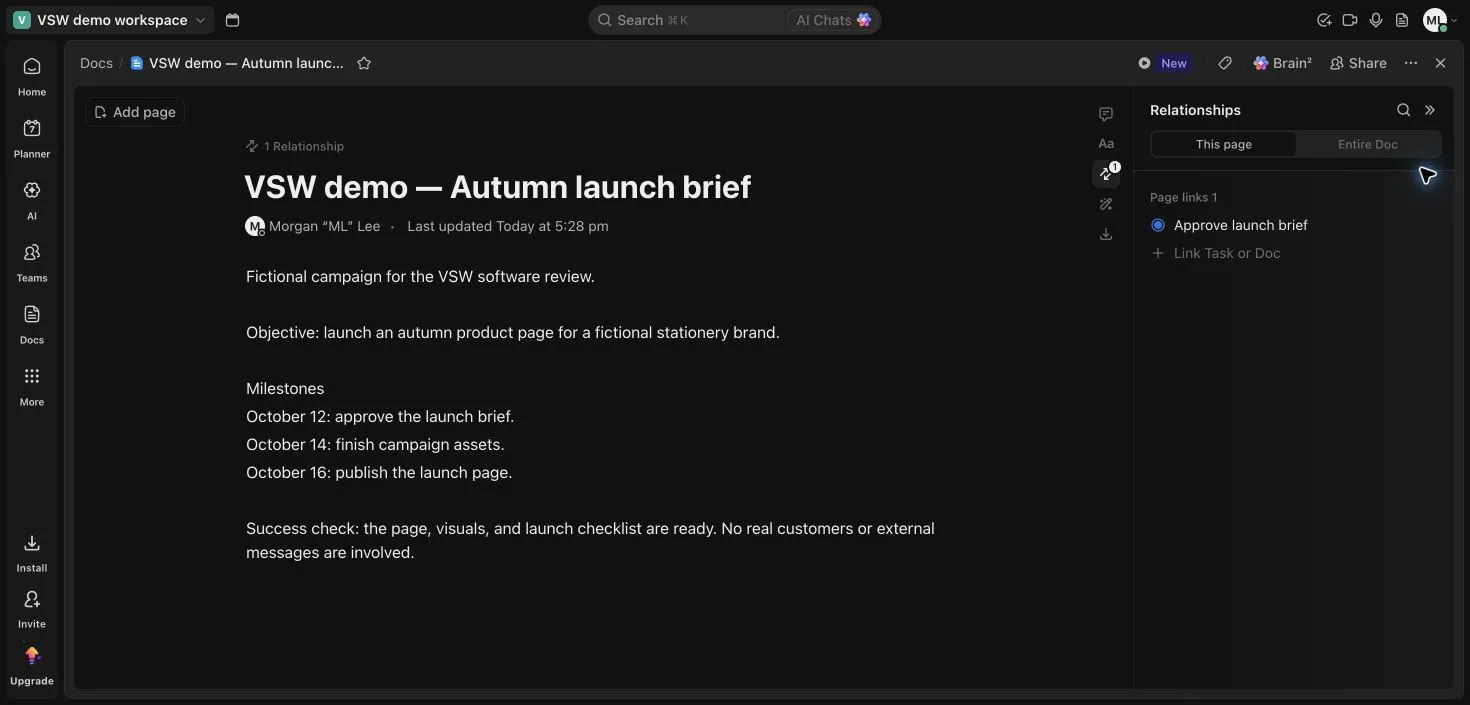
Our recorded launch workflow showed the same tasks in List and Board and connected a brief to the approval task. That makes ClickUp useful when the work and its explanation need to travel together. The range of Docs, Chat, tasks and other surfaces also creates setup choices: a shared convention helps the team know where each kind of information belongs.
Explore ClickUp in detailSupport & governance
Match the help resources and administration controls to the people responsible for running the workspace. The lowest paid tier does not imply enterprise governance.
Help and onboarding[3][4][1][9][8]
- Airtable
- Official support documentation covers bases, views, interfaces and billing. Plan documentation is especially useful when deciding who needs edit or comment access.
- ClickUp
- A Help Center and 24/7 support are advertised. Enterprise adds live onboarding training and a customer success manager.
Permissions and governance[3][4][1][9][8]
- Airtable
- Business introduces central administration and Enterprise Scale offers broader organizational governance. Match base/interface access and paid roles to the intended audience.
- ClickUp
- Enterprise lists SAML SSO, SCIM, audit logs and custom roles. Decide which controls the organization requires before choosing a base subscription.
Other approaches to consider
 Asana
Teams coordinating assigned work, deadlines and project progress, with a route into portfolios and goals.
View profile  monday.com — Work Management
Teams organizing a repeatable process through shared boards, configurable columns and visible status.
View profile  Trello
Teams whose work is clearest as cards moving through a small set of visual stages.
View profileRelated comparisons
All comparisons

Airtable vs Asana
Compare Airtable and Asana on records, tasks, planning, team fit and cost, with interface evidence and guidance on the right paid tier.

Airtable vs monday.com — Work Management
Compare Airtable and monday.com on data structure, boards, planning, integrations and seat costs, with workflow evidence and a practical buying verdict.

Airtable vs Trello
Compare Airtable and Trello on records, cards, planning views, automation and team cost, with clear fit guidance and authentic product images.

Asana vs ClickUp
Compare Asana and ClickUp on tasks, documents, planning, reporting, AI and subscription cost, with recorded workflow evidence and practical tradeoffs.
ClickUp vs Trello
Compare ClickUp and Trello on task structure, docs, boards, planning, automation and subscription costs, with clear team-fit guidance and product images.
ClickUp vs monday.com — Work Management
Compare ClickUp and monday.com on tasks, planning, AI, integrations and cost, with real interface evidence and guidance for choosing the right plan.
Airtable vs ClickUp FAQs
Is Airtable or ClickUp better for a content calendar?
Airtable is a strong fit when content must connect to campaigns, channels, assets and reusable records. ClickUp suits a calendar driven by assigned production tasks, briefs and conversations. Both provide dated views, so decide what information needs to stay connected around the deadline.
What is the annual cost for ten paid users?
Ten Airtable Team collaborators at $20 per month with annual billing cost $2,400 per year. Ten ClickUp Unlimited users at $7 cost $840. The example excludes AI charges, tax and other purchases and does not make the packages feature-equivalent.
Does Airtable have the same document workflow as ClickUp?
Airtable organizes information in typed records and tailored interfaces. ClickUp adds a dedicated Docs surface that can link to tasks. If a living brief and its approval assignment are central to the job, inspect that ClickUp workflow alongside the fields and interfaces you would build in Airtable.
Which free plan supports more people?
ClickUp Free Forever permits unlimited members within its storage and feature quotas. Airtable Free supports up to five Editors or Creators and limits records per base, with unlimited read-only collaborators. Free member counts alone do not describe the available features.
Sources & our approach
Versusware's AI-assisted editorial analysis combines official capabilities, plan and billing sources checked October 16, 2026 with the existing product evidence. Airtable observations and images come from the recorded October 5, 2026 content-calendar workflow on the Free plan. ClickUp observations and images come from the October 7, 2026 launch workflow in a Free Forever workspace with feature/AI trial allowances. Recommendations are our analysis of workflow fit, structure and subscription requirements. The full profiles retain their methodology and detailed findings.
How we review software- [1] Airtable platformChecked 2026-10-16
- [2] Airtable linked-record relationshipsChecked 2026-10-16
- [3] Airtable pricingChecked 2026-10-16
- [4] Airtable plan limits and billable collaboratorsChecked 2026-10-16
- [5] Airtable Interface DesignerChecked 2026-10-16
- [6] Airtable automation usageChecked 2026-10-16
- [7] Airtable integrationsChecked 2026-10-16
- [8] ClickUp feature directoryChecked 2026-10-16
- [9] ClickUp pricing and limitsChecked 2026-10-16
- [10] ClickUp integration catalogChecked 2026-10-16
- [11] ClickUp AI feature availabilityChecked 2026-10-16